

Building Trustworthy AI Agents: Guardrails, Evaluations, and Human-in-the-Loop
Deploying an AI agent into a live business process means it will eventually be wrong. Here's how to design systems that fail safely instead of failing silently.
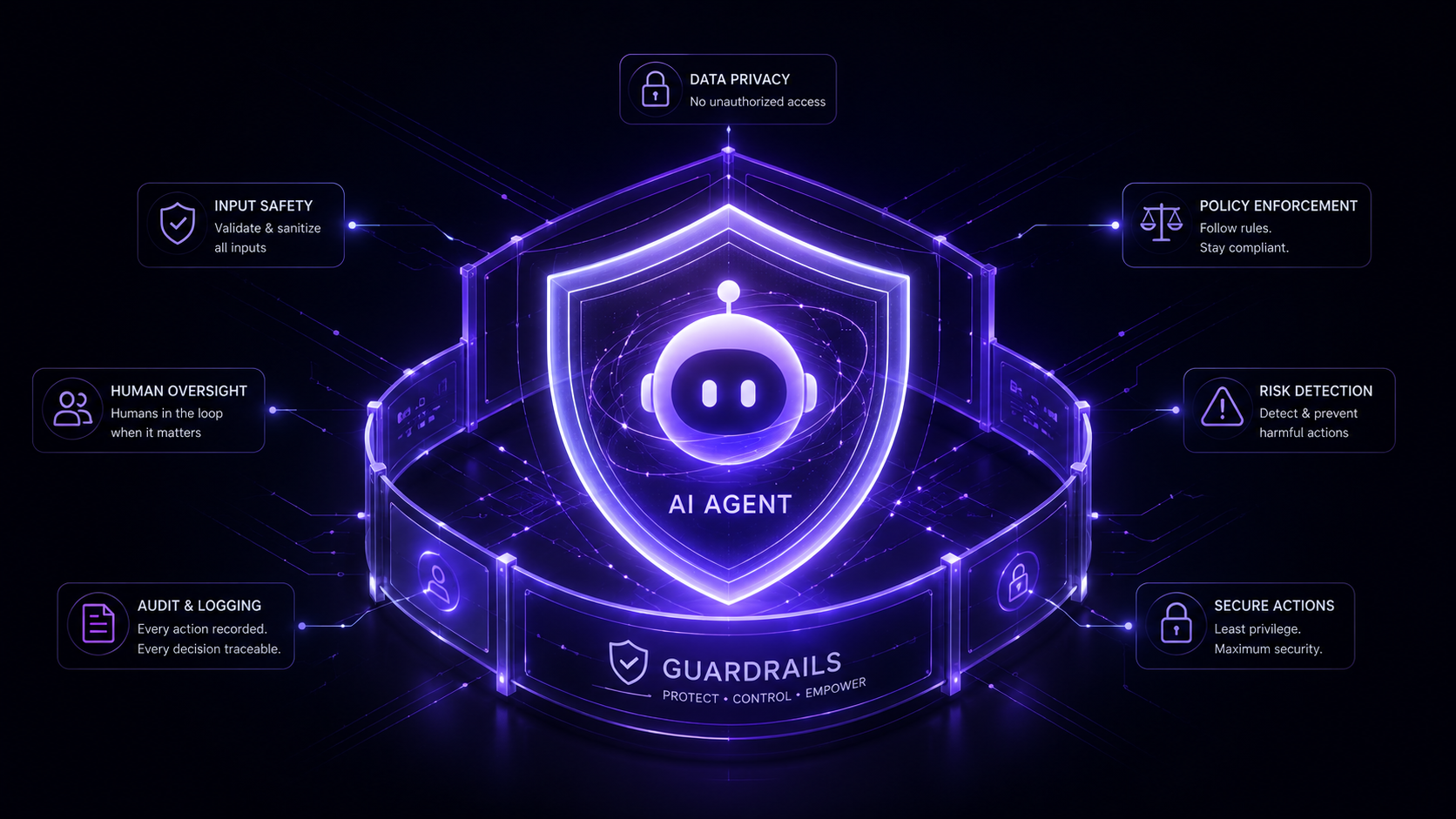
Assume the model will be wrong
The most important shift in thinking when deploying AI agents in production isn't 'how do we make the model more accurate' — it's 'what happens when it's wrong.' No model is perfect, and a system designed as if it were will fail in the worst possible way: confidently, silently, and at scale.
Trustworthy agent design starts from the opposite assumption. Every action the agent can take gets scoped by what happens if that specific action is wrong, and higher-stakes actions get proportionally more scrutiny before they execute.
Guardrails as scoped permissions, not a filter
Guardrails work best as permission boundaries rather than an output filter bolted on after generation. An agent handling billing shouldn't be capable of issuing a refund above a threshold without a second check — not because we trust the model to reason correctly about the threshold, but because the system architecture never gives it the ability to act otherwise.
This is a meaningfully different design than 'ask the model to be careful.' It moves the safety property from the model's judgment into the system's structure, which is far more reliable at scale.
Evaluations that run continuously
A model that scored well on a benchmark six months ago tells you almost nothing about how it's performing in production today, especially as your product, your users, and the underlying model itself all shift. Continuous evaluation — sampling live interactions, scoring them against defined quality criteria, and flagging regressions — turns quality from a one-time check into an ongoing signal.
The teams that catch problems early aren't the ones with the most sophisticated model. They're the ones with the tightest feedback loop between production behavior and someone looking at it.
Where humans stay in the loop
Full automation isn't the end goal for every workflow — appropriate automation is. High-frequency, low-stakes decisions are strong automation candidates. Low-frequency, high-stakes, or ambiguous decisions should route to a human, with the agent doing the preparation work (gathering context, drafting a response, flagging the relevant policy) so the human's job becomes reviewing rather than starting from scratch.
Want to see this in production?
Talk to us about Chief Voice, X-Suite, or a custom-built AI solution for your business.
Talk to Sales