

LLM Latency: Why Sub-100ms Matters in Real-Time Voice Applications
A breakdown of where latency actually accumulates in a voice AI pipeline, and the engineering tradeoffs that separate a system that feels instant from one that feels laggy.
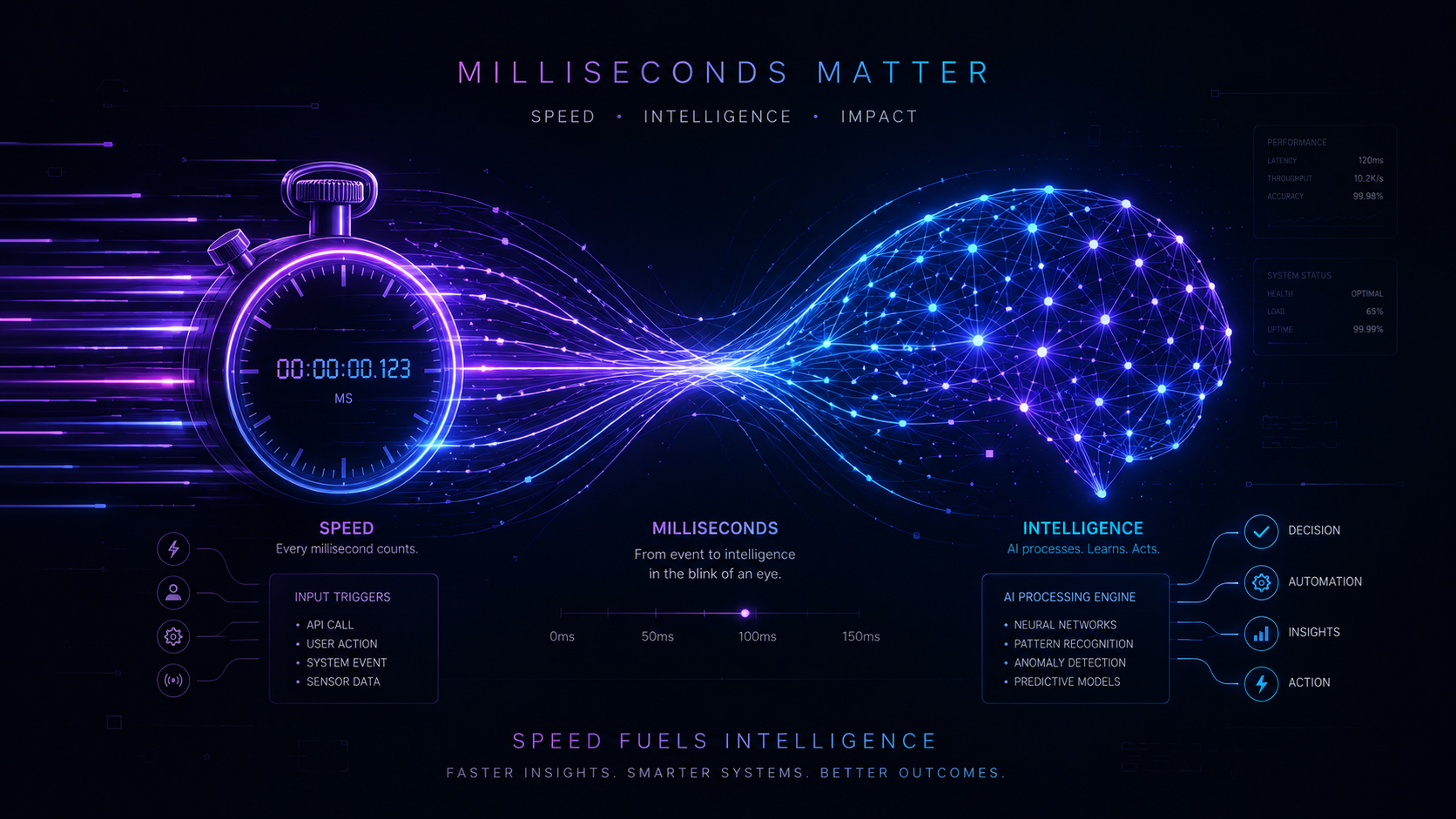
Where the milliseconds go
A voice AI response isn't one operation — it's a chain. Audio has to be captured and streamed, transcribed into text, reasoned over by a language model, converted back into speech, and streamed to the caller. Each hop adds latency, and in a naive implementation those hops run sequentially, stacking delays into something a caller can clearly feel.
Network round-trips alone can eat 50-100ms each way if infrastructure isn't colocated properly. Add a language model that waits for a full response before starting synthesis, and you can easily land at 2-3 seconds of dead air before the caller hears anything — an eternity in conversation.
Streaming everything
The single highest-leverage change is streaming at every stage instead of waiting for complete units. Speech recognition should emit partial transcripts as audio arrives, not wait for silence. The language model should generate token-by-token. Speech synthesis should start converting the first sentence of a response while the model is still generating the rest.
Done correctly, this turns a sequential pipeline into an overlapping one, where the caller starts hearing a reply while the system is technically still 'thinking' about the end of it — which is closer to how human conversation actually works.
Model size vs. response time
There's a real tradeoff between using a larger, more capable model and hitting tight latency targets. The answer isn't always 'use a smaller model' — it's routing. Simple, high-frequency intents (confirm an appointment, check a balance) can be handled by fast, lightweight reasoning, while complex or ambiguous requests route to a more capable model that takes slightly longer, because the caller will tolerate a beat of extra thought on a hard question in a way they won't tolerate it on 'what's my order status.'
The human perception threshold
Research on conversational turn-taking consistently points to roughly 200ms as the gap humans expect between one person finishing speaking and the other responding — much less than most people would guess. Systems that land meaningfully under that threshold stop feeling like 'a bot with good manners' and start feeling like a conversation. That's the bar sub-100ms pipeline latency is built to clear, leaving headroom for network variance.
Want to see this in production?
Talk to us about Chief Voice, X-Suite, or a custom-built AI solution for your business.
Talk to Sales