

RAG vs Fine-Tuning: Choosing the Right Approach for Enterprise AI
Two of the most common ways to adapt an LLM to your business — retrieval and fine-tuning — solve different problems. Most teams need both, applied to different parts of the system.
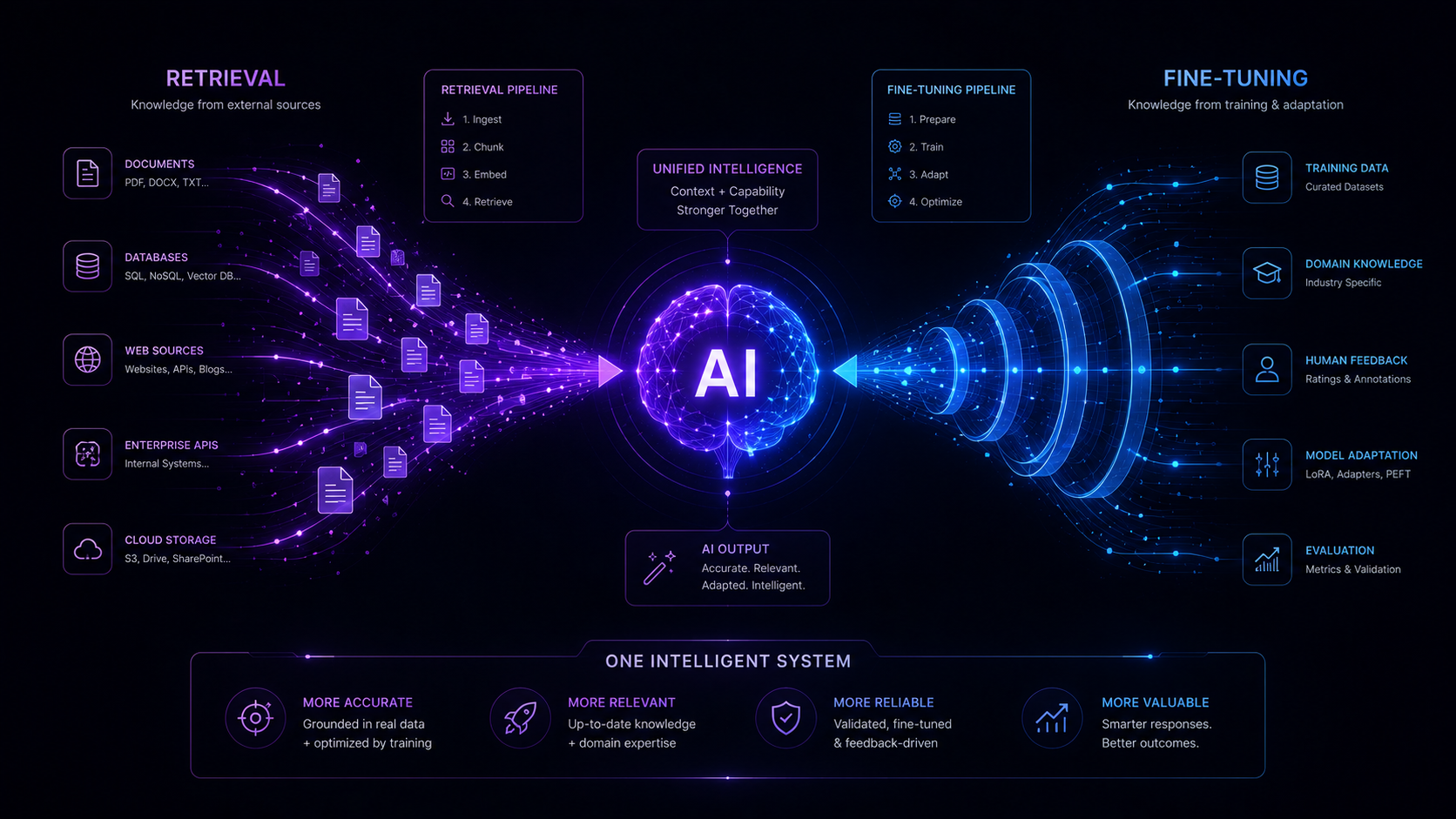
Two different problems that get conflated
'How do we make the AI know our company's information' and 'how do we make the AI behave the way we want' sound like the same question, but they're solved by different techniques. Retrieval-augmented generation (RAG) is fundamentally about giving the model access to facts it wasn't trained on. Fine-tuning is fundamentally about shaping how the model behaves — its tone, its format, its judgment on edge cases.
Teams that default to fine-tuning for a knowledge problem end up with a model that's memorized a snapshot of information that goes stale the moment it changes. Teams that default to RAG for a behavior problem end up stuffing enormous instructions into every prompt, hoping the model reliably follows them.
When RAG is the right tool
RAG shines when the underlying information changes frequently, needs to be traceable back to a source, or is too large to fit in a single context window — product catalogs, policy documents, support tickets, internal wikis. Because the model retrieves relevant documents at query time rather than 'remembering' them from training, updating a policy document updates the system's knowledge immediately, with no retraining required.
When fine-tuning is the right tool
Fine-tuning earns its cost when you need consistent behavior that's hard to fully specify in a prompt — a very particular tone of voice, a domain-specific way of structuring responses, or reliable performance on a narrow, well-defined task where you have enough labeled examples to train on. It's less about facts and more about muscle memory.
The pattern that actually works in production
Most mature enterprise AI systems use both: a fine-tuned or carefully prompted model that has the right behavior and judgment, given access to a RAG pipeline that supplies it with current, traceable facts. Treating the choice as either/or usually means picking the wrong architecture for at least half the problem.
Want to see this in production?
Talk to us about Chief Voice, X-Suite, or a custom-built AI solution for your business.
Talk to Sales